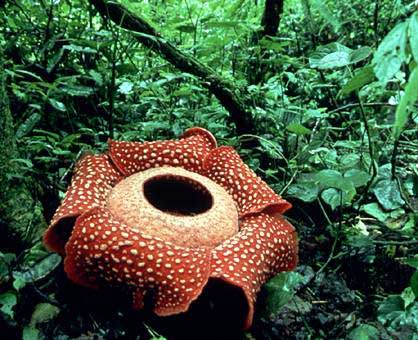
 Rafflesia: Rafflesia (Rafflesia arnoldii) is a flowering parasitic plant that is found in the rainforests of Indonesia. The plant does not produce leaves, stems or roots, therefore it is holoparasite. Rafflesia is a nonphotosynthetic vine which grows as individual threads. These thread-like strands grow within their host, usually the Tetrastigma vine.
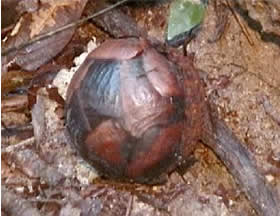 Rafflesia can only be seen when it is ready to reproduce because then, and only then do the parasitic growths on the vine develop and burst through their host's bark as an strange-looking cabbage.
After nine months the bud opens and becomes the well-known
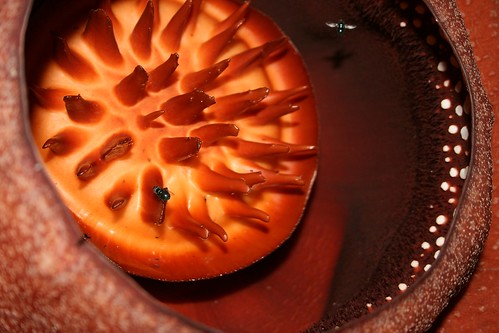 rafflesia flower which smells of rotting flesh. The flower is the largest in the world and can grow up to three feet in diameter. Its putrid smell is used to attract insects which then pollinate the flower.
Inside the flower are numerous spikes whose functions are unknown. These mysterious spikes hold gallons of nectar.
Thurber's Stemsucker:
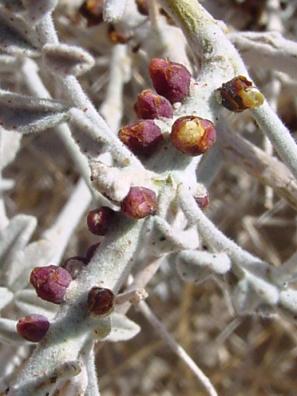 Thurber's Stemsucker (Pilostyles thurberi) is a rare parasitic plant in the family of Rafflesiaceae. It is a wildflower stem parasite that lives completely within the stems of a small desert shrub called dyeweed. The parasite is only visible when the buds appear.
 Thurber's Stemsucker is a holoparasite with no true stem, roots, or leaves and is completely dependent on its host dyweed plant. From this shrub, the parasite gains its vital nutrients and water.
 Once a year small buds protrude from the hosts stem and resemble small, red pimples. After a certain period of time, these buds bloom into small flowers with no true petals and are so small they are only 2-3mm in diameter.
These buds produce a saffron yellow dye. This dye is used in local Indian artwork in California, Arizona, and Colorado.
 Cytinus Ruber: (Cytinus hypocistis) These root parasites get thier nutrients entirely from host plant therefore they are holoparasites. They are part of the genus Cytinus and are related to Rafflesia. Cytinus Ruber lives inside its host and can only be seen from March to May when it flowers. It is found in Algeria, Corsica, Crete, Croatia, Cyprus, East Aegean Islands, France, Greece, Italy and Libya.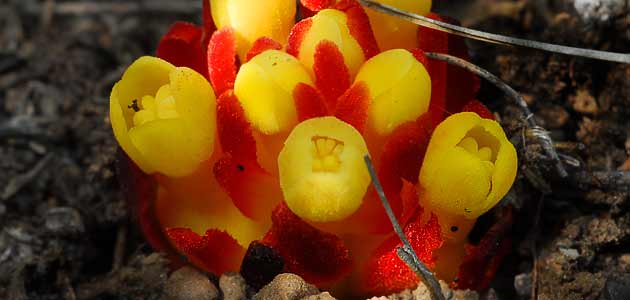
It has bright red and white fleshy flowers that grow in clusters at ground level. The flowers are usually around three inches tall and are hidden beneath the base of the host plant so they are difficult to see.
The plant is edable and is also used medicinally for astringent, which constricts body tissue.

No comments:
Post a Comment